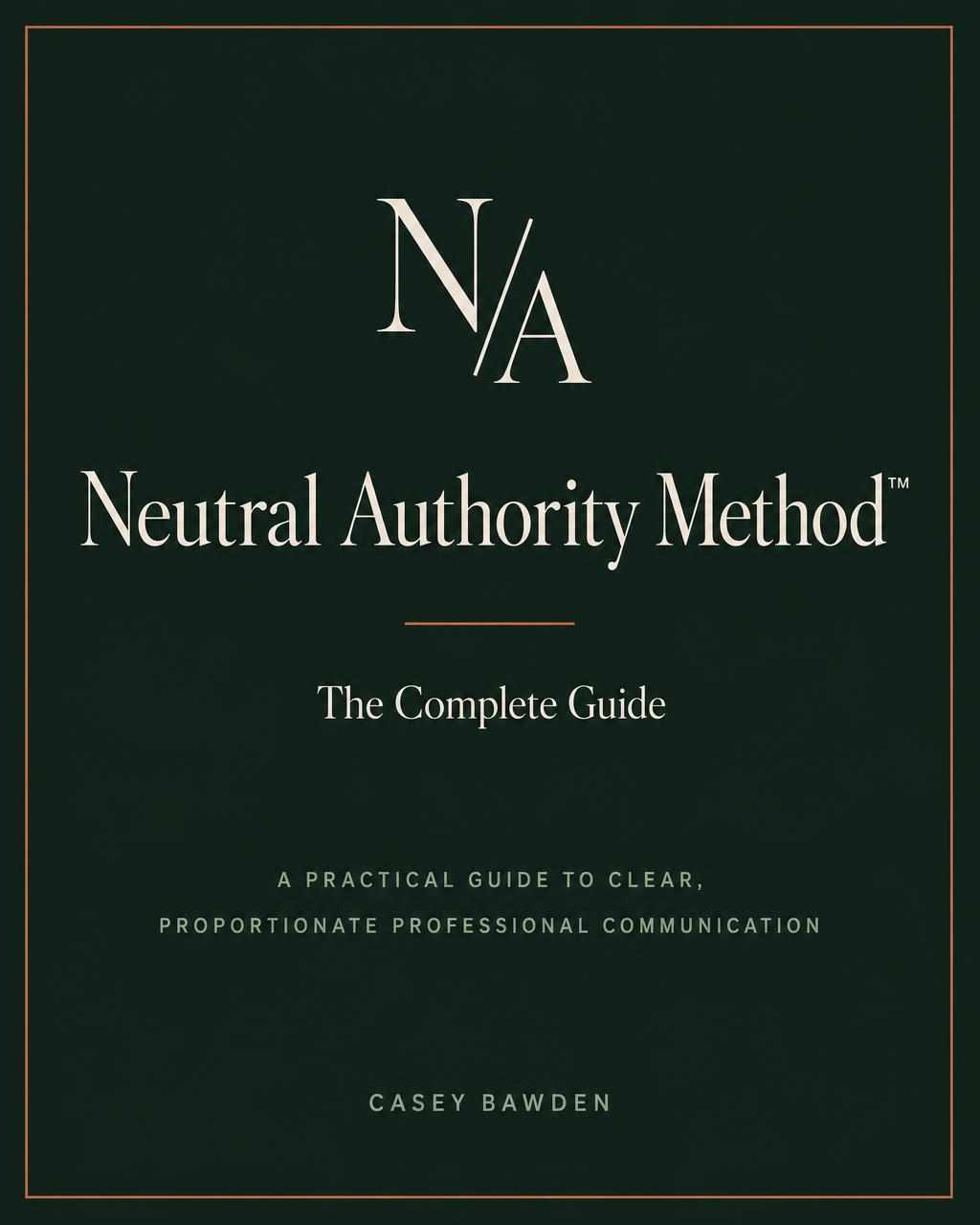
Neutral Authority Method™
The Complete Guide
A practical method for examining the language used in professional and commercial communication.
Most professional communication does not need to become more forceful. It needs to become more deliberate.
Neutral Authority Method gives you a practical way to examine what your language is doing: where it accurately reflects the situation, and where habitual apology, qualification, negative framing or explanation has begun to obscure the point.
Digital guide · PDF · $49 AUD
The language around the point
The facts stay the same. What the reader takes from them does not.
A request can become apologetic before anybody has objected to it.
A confirmed position can begin to sound uncertain.
Routine information can be framed as bad news before the situation requires that judgement.
A straightforward explanation can keep expanding long after the reader has enough information.
None of these habits automatically makes a message wrong.
The question is whether the language is accurate: about what happened, and about how sure you are.
Neutral Authority Method gives you a framework for making that judgement.
The Method
The three core patterns.
01
Reflex Apology
Apology that appears automatically rather than because responsibility or impact requires it.
02
Hedging
Qualification that exceeds the uncertainty present in the situation.
03
Negative Framing
Language that characterises information negatively before the facts or context require that judgement.
An apology may be necessary. Qualification may be accurate. Difficult information may need to be acknowledged directly.
Context decides.
What you receive
77 pages, twelve chapters and four reference sections.
The Complete Guide is a single digital book. Read it in sequence to understand the Method, then return to individual sections when a particular communication situation requires them.
The Complete Guide develops a practical way to review your own professional communication. It shows you how to identify what particular language is doing, test it against the facts, certainty, responsibility, purpose and context, and decide more deliberately what should remain, change or be added.
The framework
- A self-review using your last ten messages, so the patterns can be examined in your own writing before the framework is applied more broadly.
- The three core patterns: Reflex Apology, Hedging and Negative Framing.
- Related behaviours including over-explanation, cushioning, self-minimisation and commitments that become unnecessarily tentative.
- Four replacement choices for deciding what a sentence needs once unnecessary language is removed.
- A four-step review process: notice, test, revise, check.
Application
- Responsibility, apology and repair, including partial, shared and unclear responsibility.
- Boundaries, complaints, escalation and difficult news.
- Hierarchy, meetings, executive updates, policy, documentation and live conversation.
- Pricing, quotes, overdue accounts, scope, rate increases and pushback.
- Using AI as an editor while retaining responsibility for the judgement.
Reference
- A rewrite library of 30 worked situations, each showing a common version, one possible revision and what changed.
- Seven complete messages with subject lines, greetings and closes, annotated with the reasoning behind each part.
- A 48-entry phrase reference across six categories, with the test that determines whether the language belongs.
- Twelve common questions, a before-you-send checklist and a thirty-day practice structure.
Digital PDF. 77 pages. Suitable for reading on screen or printing.
Related behaviours
The effect often comes from the accumulation of qualifying, cushioning or explanatory language rather than any single phrase.
The guide also examines behaviours that frequently appear alongside the three core patterns:
- over-explanation
- unnecessary cushioning
- pre-emptive justification
- unclear responsibility
- vague requests and commitments
- excessive context
- language that minimises a position unnecessarily
These sit alongside the three patterns rather than inside them. They rarely cause the problem on their own, but they bury the point.
The complete guide
Recognition is the first stage. Revision is where the Method becomes practical.
Part I
The Method
- What Neutral Authority Method is
- What structural communication means
- Neutrality, authority and context
- The three core patterns
Part II
Seeing the patterns
- Reflex Apology
- Hedging
- Negative Framing
- Over-explanation and cushioning
- Responsibility and agency
Part III
Applying the Method
- Requests and follow-ups
- Difficult information
- Apology and acknowledgement
- Boundaries and scope
- Pricing and commercial communication
- Hierarchy and seniority
- High-stakes communication
Part IV
Beyond email
- Spoken communication
- Why written communication is easier to change first
- Moving the Method into live conversation
Part V
Using it yourself
- A practical review process
- Before-and-after examples
- Quick-reference tools
- Practice material
Where to begin
Written communication can be reviewed before it is sent, making habitual language easier to identify and revise.
Once you know what you are looking for, the patterns are often easier to recognise on the page.
You can review a sentence. Remove something. Put it back. Compare the versions.
Ask whether the qualification is accurate, whether the apology is warranted or whether the explanation is necessary.
Spoken communication is harder because the same judgement has to happen in real time.
That is why the guide begins with written communication and then moves into conversation.
The underlying judgement is the same. The speed is different.
With practice, the Method gives you a structured way to review professional communication: to identify what the language is doing, test it against the facts and context, and make a more deliberate decision about what to keep, change or add.
In practice
The objective is a sound judgement about what the situation requires.
Before
“Sorry to chase again. I just wanted to quickly check whether you’d had a chance to look at this at all?”
One possible revision
“Following up on the document sent Tuesday. Could you confirm a review date?”
In the second version the routine follow-up is no longer introduced as an imposition, and the required next step is explicit.
Examples are illustrative. The appropriate wording depends on the facts, responsibilities, relationship and context.
What the Method is not
You keep your own voice.
The Method leaves room for individual style, professional register and context. Its concern is whether the choices within the message are deliberate and proportionate to the situation.
Applying it requires judgement, which is why the guide shows the reasoning behind each revision rather than a fixed form of words.
Neutral Authority Method is not
- a ban on words such as “sorry,” “just” or “perhaps”
- a rule that shorter is always better
- advice to become blunt or aggressive
- a requirement to remove warmth or courtesy
- a substitute for genuine uncertainty
- a reason to avoid responsibility
- a collection of universal scripts
AI and the Method
AI can rewrite a sentence. The judgement still has to come from you.
An AI tool can rewrite professional communication, and The Complete Guide includes a chapter on using one as an editor.
The difficulty is context. A model does not automatically know whether a date is confirmed or estimated, where responsibility sits, what was agreed in a meeting, what a contract requires, or which organisational constraints apply. Without enough context, a polished revision can still misstate the position.
It may remove a caveat that matters, introduce certainty the facts do not support, or accept responsibility that is not yours to accept.
The Method provides the judgement that comes before the rewrite: what the situation contains, what the language is doing, and what the message requires.
That makes AI more useful as an editing tool. Instead of asking it to make a message “more authoritative”, you can ask a narrower question about the language you have already examined.
Written by Casey Bawden, who developed the Method on her own commercial correspondence. More on the About page.
Who it’s for
For people whose work requires them to communicate positions clearly.
The guide is written for professionals, managers, business owners and people working in commercial environments who regularly need to:
- make requests
- follow up
- communicate decisions
- set boundaries
- discuss price or scope
- deliver difficult information
- acknowledge mistakes
- communicate across hierarchy
- write when the stakes feel higher than usual
The guide is for people who have reason to examine their professional communication carefully, whatever their usual manner or level of seniority.
Before you decide
The reasoning is available to read before you buy.
Thirty-six articles in the Journal examine the same communication patterns across requests, follow-ups, pricing, scope, meetings, references, contracts and difficult messages. They are free to read and require no email address.
The Complete Guide brings that reasoning into one structured method and adds the application and reference material. The Journal gives you a way to assess the approach before deciding whether the full guide is useful to you.
The Complete Guide
Neutral Authority Method: The Complete Guide
Read it from beginning to end, or return to individual sections when a particular communication situation arises.
What’s included
- 77 pages across twelve chapters
- The three core patterns: Reflex Apology, Hedging and Negative Framing
- A 30-situation rewrite library, before and after, with the reasoning shown
- Seven complete annotated messages
- A 48-entry phrase reference
- Application to responsibility, boundaries, difficult information and commercial communication
- The transition from written to spoken communication
30-day money-back guarantee. If the guide is not what you expected, request a refund within 30 days of purchase. Refunds are processed through Paddle. See the Refund Policy.
Purchase information
- Digital product. No physical item is shipped.
- Delivered immediately by email as a downloadable PDF.
- Supplied for the purchaser’s individual use.
- Payments are processed by Paddle, the merchant of record for this sale.
- Purchases are subject to the Terms of Use & Sale.
About this material
Neutral Authority Method is educational material, not legal, financial, employment, psychological or other professional advice. You remain responsible for reviewing and approving your own communication before using it.
Read the full Disclaimer.
Questions
An apology is appropriate when responsibility or impact warrants it. The Method focuses on distinguishing deliberate apology from apology that appears automatically.
Apply the Method to the communication you already write.
30-day money-back guarantee. If the guide is not what you expected, request a refund within 30 days of purchase. Refunds are processed through Paddle. See the Refund Policy.